Guides
Sewer Backup Insurance Claim Canada: Contractor Workflow
A sewer backup insurance claim Canada guide for restoration firms and drain contractors covers intake, documentation, scope, authorization and billing.
What to take away
- This sewer backup insurance claim Canada workflow starts with intake: the insurer's claim center sets urgency on the first call, then assigns a field adjuster and an approved restoration firm.
- Sewer backup coverage is usually an endorsement with its own sub-limit and deductible, separate from the dwelling limit.
- Restoration firms hand drain work to plumbers who can send a licence number, an after-hours rate, an insurance certificate and a written scope in one reply.
- Adjusters pay mitigation when the file shows cause, extent and cost: photos, CCTV footage with distance readings, dated moisture logs and an itemised invoice.
- Get an authorisation number before you pass the initial cap. Work billed past it without one is the most common dispute on these files.
How a Canadian insurer triages the claim
Intake happens by call centre, broker or online portal. The agent records the loss date, the address, whether the owner occupies the property, and whether sewage is still entering. That call sets the urgency tier.
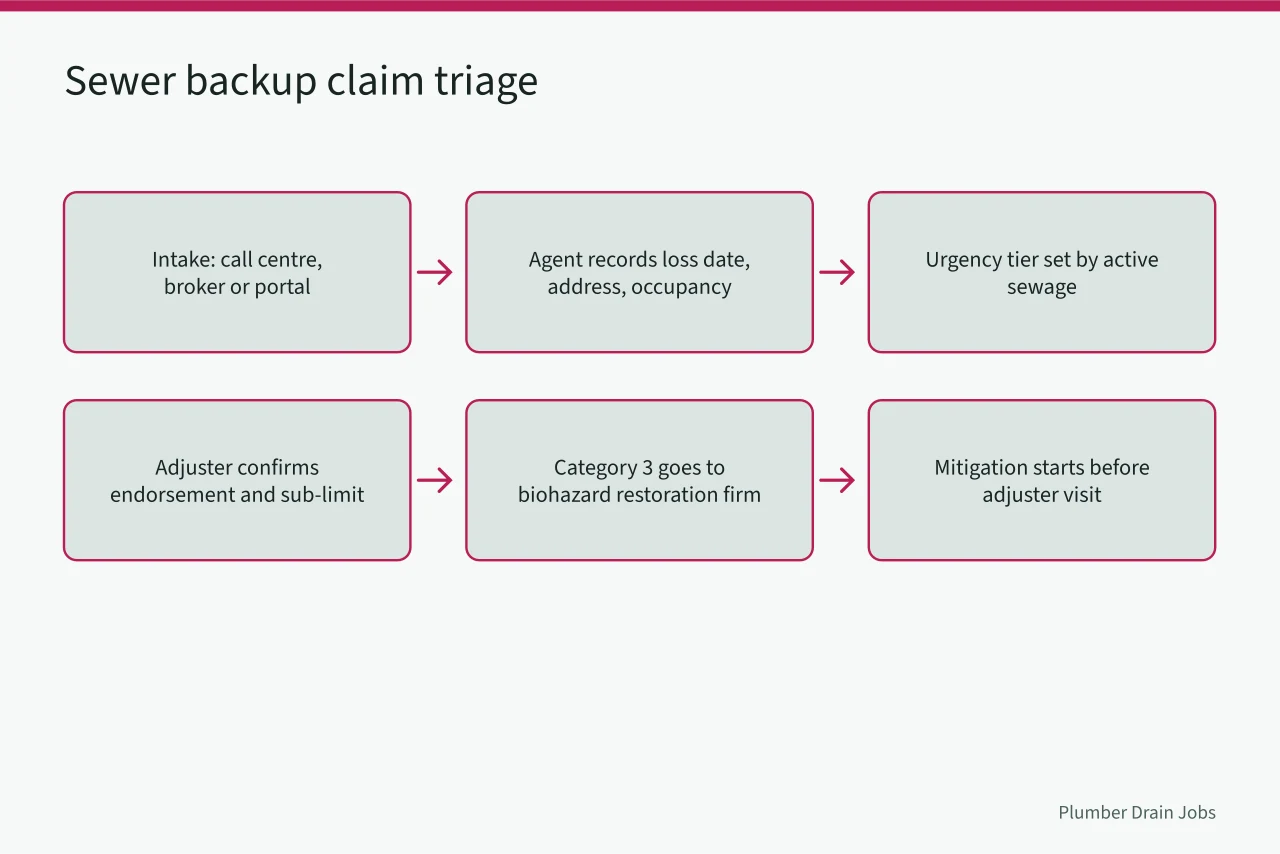
Sewer backup sits in most homeowner policies as an endorsement, not as standard contents or dwelling coverage. The endorsement carries a sub-limit well below the dwelling limit and often its own deductible. The adjuster confirms it exists before anyone dispatches a contractor.
A backwater valve changes the questions. Where one is present and failed, or was wedged open, the adjuster asks who installed it and when it was last serviced. Missing records turn a covered loss into a maintenance question.
Category 3 water, which is sewage-contaminated, goes to a restoration firm with biohazard capability. Clean water from a failed supply line goes to a general restoration firm or straight to a plumber.
Insurers in Ontario, British Columbia, Alberta and Quebec run approved vendor networks. A network firm takes the assignment and subcontracts the drain work. If you are not on the network, your route in is the restoration firm, not the insurer.
Mitigation usually starts before the adjuster visits. The insurer authorises a set number of hours for extraction, containment and drying, then reviews the file. Anything past that cap needs a written authorisation number.
Provincial rules decide who may do the work. Quebec requires a licence from the Régie du bâtiment du Québec for construction and renovation contractors. British Columbia regulates gas and some plumbing work through Technical Safety BC.
Alberta, Ontario and the Atlantic provinces license plumbers through their own trade regulators.
Red Seal certification travels between provinces, but insurers still ask for the provincial licence number covering the claim address.
Plumbing and drain installations sit inside the National Building Code of Canada, which insurers and municipal inspectors both reference when a repair touches structure or fire separations.
What restoration firms ask before they assign work
The restoration firm holds the insurer contract and hands drain tasks to subtrades. It needs a plumber who answers at 2 a.m. in February, arrives with a camera, and writes a report the adjuster can file.
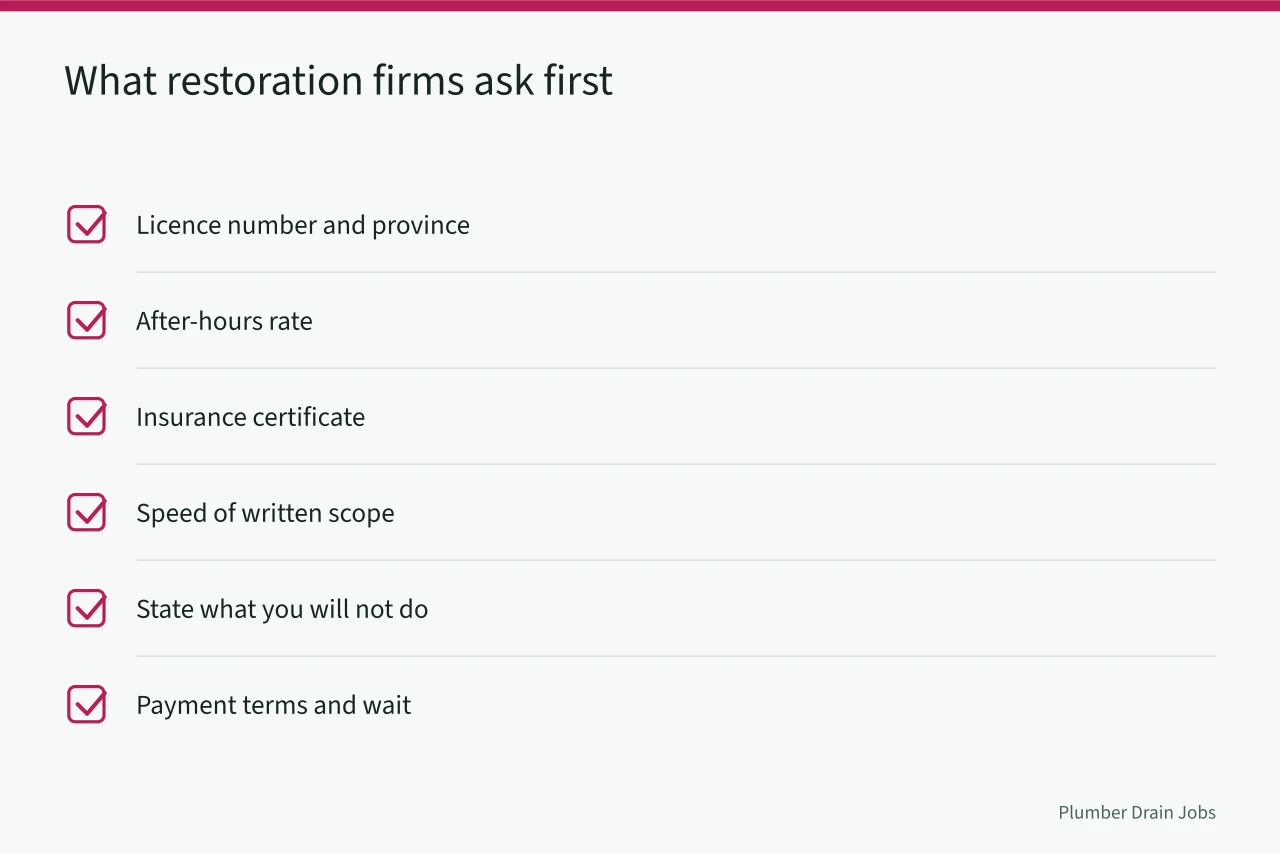
Four answers come before any assignment: your licence number and province, your after-hours rate, your insurance certificate, and how fast you can send a written scope. Contractors who answer all four in one email get called back.
Say what you will not do. If you do not handle asbestos-containing floor tile, or mould beyond a small area, state it early. Restoration firms keep subtrade lists by capability, and an unclear scope wastes time on a file that is already urgent.
The referral is not a favour. The restoration firm answers to the insurer for the whole file, so your delay becomes their delay. A missed drying check or a missing invoice can hold up the entire claim payment.
Payment terms matter. Many restoration firms pay subtrades after the insurer pays them, which runs 30 to 90 days. Ask before you take the job, and price the wait into your rate.
Put the terms in one page: insurer file number, scope, rate, the documentation you will supply, and the payment trigger. Firms that run clear written terms also find that complaint handling gets simpler, because the agreement answers most disputes before they start.
Documentation the adjuster's decision rests on
The decision rests on the file, not the phone call. Your paperwork has to show cause, extent and cost. Miss one and the claim weakens.
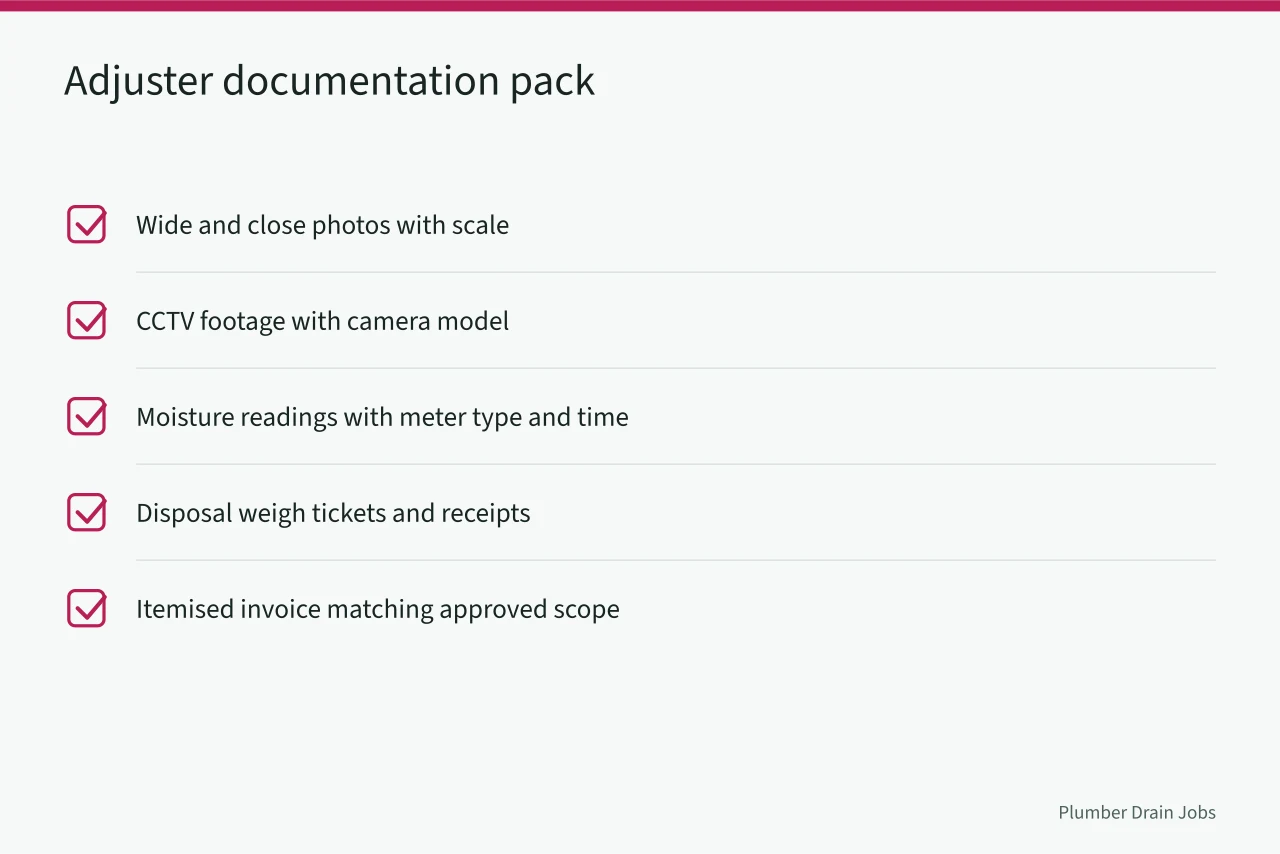
Photos come first. Wide shots of the affected room before extraction, then close shots of the source. Photograph the floor drain, the cleanout, the backup point and any sewage line on the floor. Put a tape measure or a coin in frame for scale.
Camera footage is the strongest evidence on a drain claim. A CCTV inspection shows roots, offset joints, bellies, grease or collapsed pipe. Save the footage to a file, note the camera model and the distance readings, and attach it to your report. Adjusters accept footage far more readily than a written opinion.
Moisture readings prove the drying scope. Record them at each visit with the meter type, the location and the time. A log showing moisture content falling over three days justifies the equipment hours you are billing.
Keep disposal records. Sewage-contaminated carpet, drywall and insulation must be bagged and taken to a licensed facility. Weigh tickets and facility receipts turn a round-number disposal charge into a payable line.
The invoice must match the scope. Itemise labour hours, equipment days, disposal, camera inspection and materials. Do not bundle. A line the adjuster cannot match to the approved scope gets queried, and the query delays payment.
Run this list before you send a file:
- Insurer name, claim number and adjuster contact on every page
- Wide and close photos of the source and the affected area
- CCTV footage with camera model and distance readings
- Moisture readings by date, location and meter type
- Authorisation number for work beyond the initial cap
- Itemised invoice matching the approved scope, with licence and insurance attached
Keep a copy of everything. If the claim is disputed later, your file is your defence. It also settles arguments about service standards compared with what was actually delivered, because the record answers most questions.
Scope language insurers approve on drain repairs
Insurers approve scopes that are specific, code-referenced and split into stages. Vague scopes come back. A line reading "repair sewer line" invites a query; a line naming pipe length, diameter, material, endpoints and fittings does not.
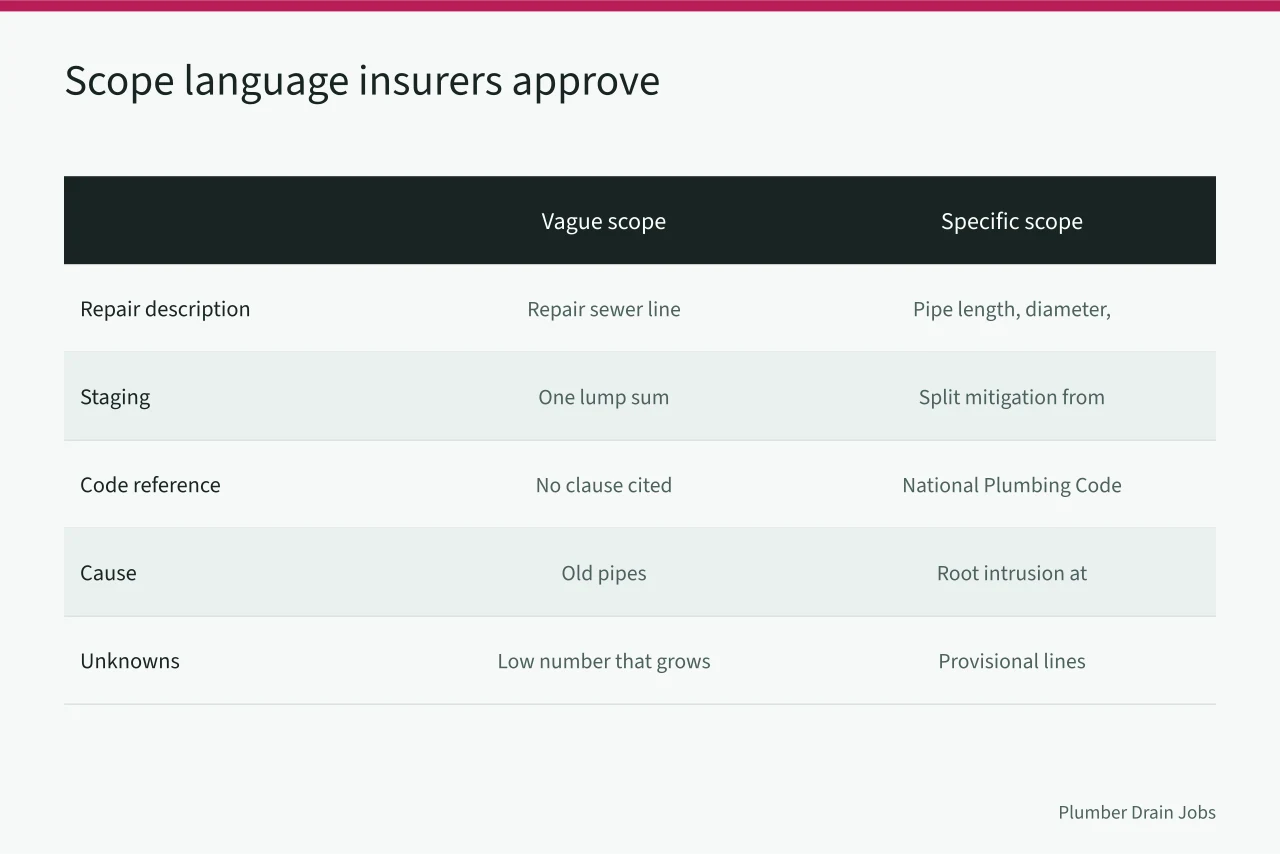
Split emergency mitigation from permanent repair. Mitigation covers extraction, containment, disinfection, drying and disposal. Permanent repair covers the drain itself, plus reinstatement of flooring, drywall or fixtures. Insurers often pay these from different parts of the policy, so mixing them causes confusion.
Reference the code where it applies. The National Plumbing Code of Canada sets provisions for drain sizing, slope, cleanouts and venting that shape a compliant repair. Citing the clause tells the adjuster the work is not optional.
State the cause. Root intrusion at a joint 9 metres from the cleanout is a cause. Old pipes is not. Cause decides coverage, so the adjuster needs it in your words.
Add exclusions and assumptions. If you cannot see behind a finished wall, say so. If the repair may need a permit or a road cut, note it as a possible extra. Adjusters prefer a scope with stated unknowns to a low number that grows later.
Price the unknowns separately and label them provisional. A provisional line is understood to move; a firm line that changes invites a dispute.
On larger jobs, describe the quality-control process behind the scope, so the adjuster understands your inspection and sign-off routine. That record also helps if the file is reviewed later.
Billing emergency and mitigation work
Adjusters are measured on cycle time and cost. Make their file easy to close: one contact point, one format, no surprises.
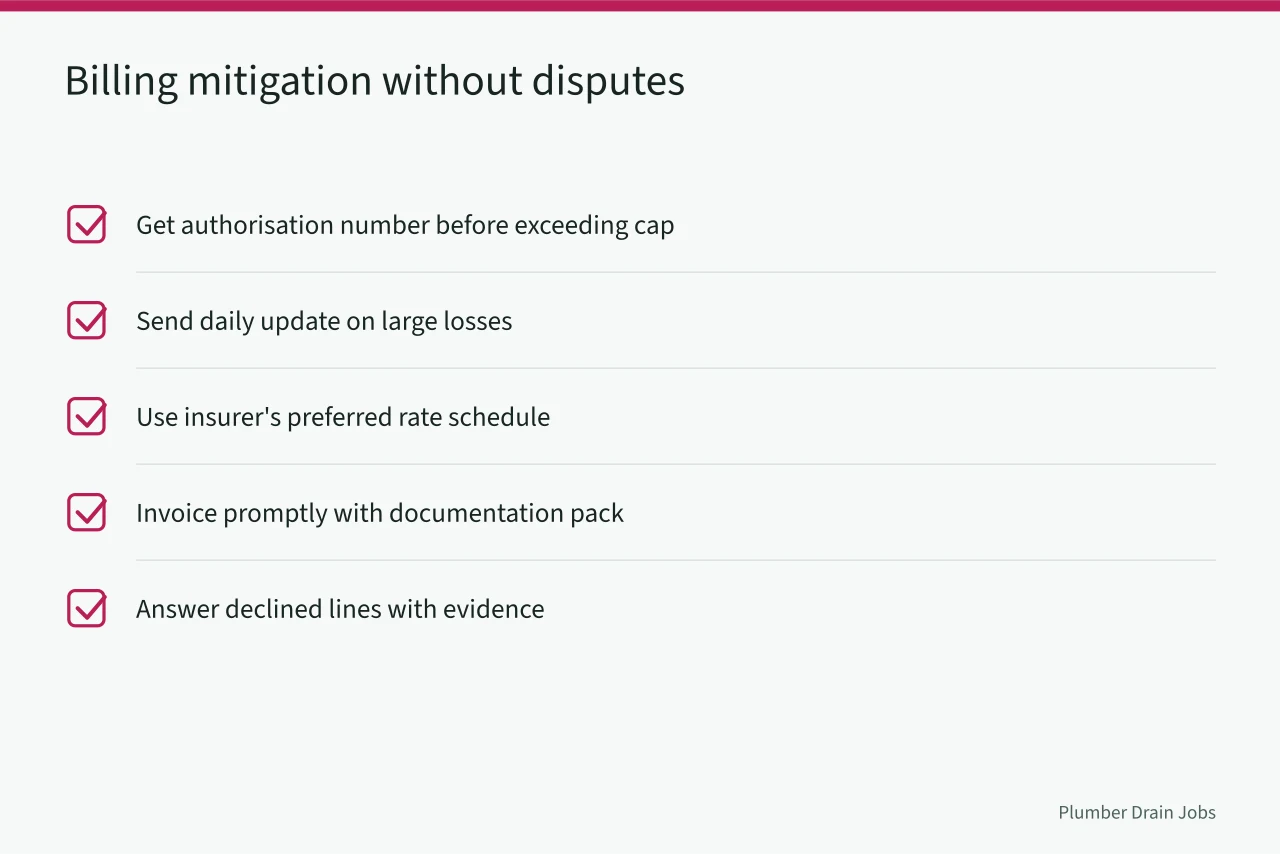
Get an authorisation number before you exceed the initial cap. Mitigation billing without one is the most common source of disputes. A five-minute call to the adjuster or the restoration coordinator protects the whole invoice.
Send a daily update on large losses. A short email with photos, moisture readings and hours used keeps the adjuster informed and heads off a mid-file audit. Adjusters who receive updates rarely query the final invoice.
Use the insurer's preferred rate schedule where one exists. Many Canadian insurers publish unit rates for extraction, air movers, dehumidifiers and disposal. Billing above the schedule needs justification, such as after-hours access or a confined space.
Invoice promptly. A file that sits three weeks invites questions about the delay. Attach the documentation pack to the invoice, not in a separate email.
When a line is declined, ask why in writing and answer with evidence. A declined equipment day often comes back with the drying log. A declined disposal charge comes back with the weigh ticket.
Track adjuster relationships the way you track your books. Knowing who pays on time and who queries every line helps you set rates and manage cash flow.
Worked example: a two-day mitigation file
A 1960s bungalow in Hamilton, Ontario. Sewage backs up through the basement floor drain on a Saturday night.
- Saturday, 11 p.m.extract standing water, set containment, photograph the floor drain and cleanout, call the insurer's after-hours line and log the authorisation number.
- Sundayrun a CCTV inspection from the cleanout, find root intrusion at a joint 9 metres out, and email the footage and moisture readings to the adjuster.
- Mondaysend a split scope, mitigation to close out drying in five days, permanent drain repair priced separately, with materials, disposal and camera inspection itemised.
The adjuster approves mitigation the same day. The drain repair waits for a second review, and the footage answers every question on cause.
Why these claims get denied
Denials are usually about coverage, not about your work. Knowing the reasons lets you warn the homeowner and protect your invoice.
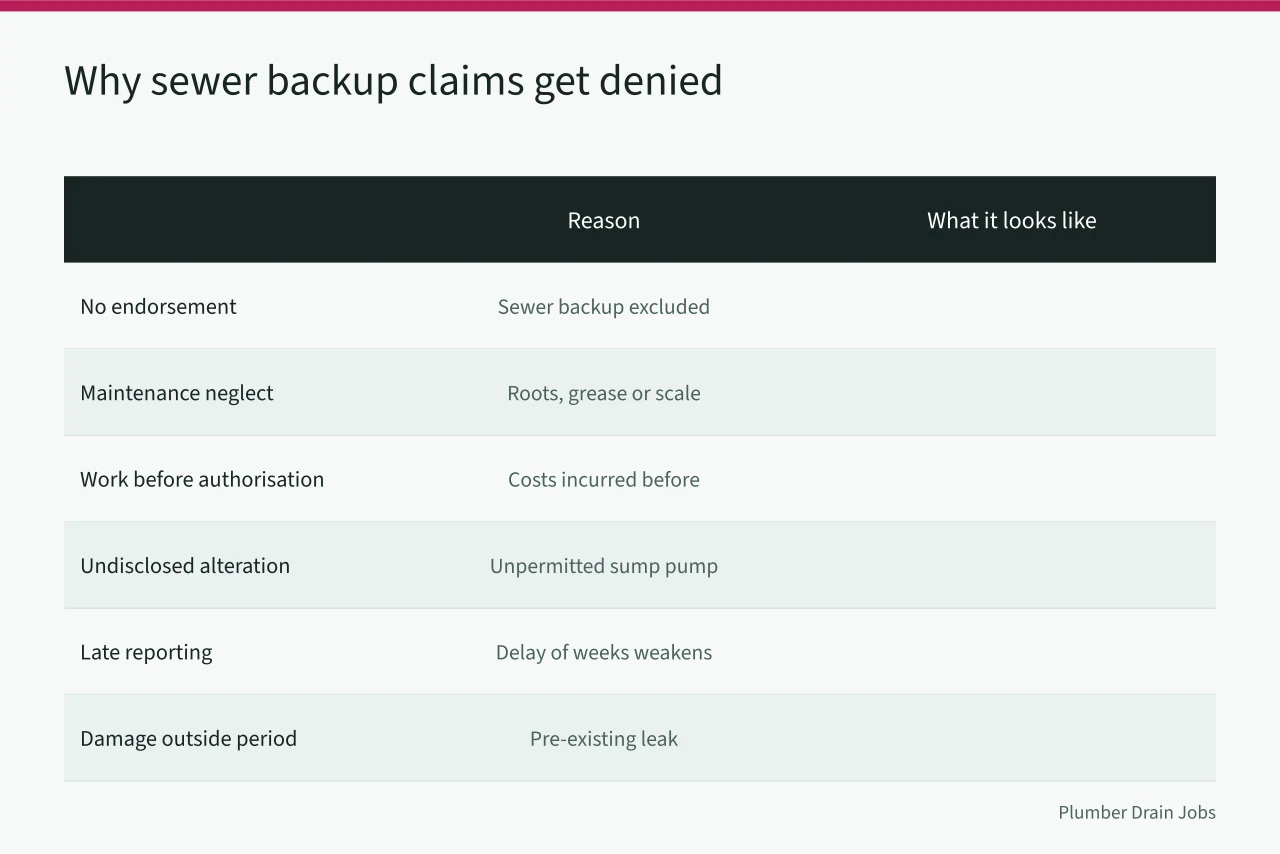
| Reason | What it looks like |
|---|---|
| No endorsement | Standard homeowner policies often exclude sewer backup unless the endorsement was bought |
| Maintenance neglect | Roots, grease or scale never addressed gets treated as wear and tear |
| Work before authorisation | Costs incurred before the claim was reported may be declined |
| Undisclosed alteration | An unpermitted sump pump, backwater valve or basement bathroom can void coverage for that area |
| Late reporting | Most policies require prompt notice, and a delay of weeks weakens the claim |
| Damage outside the period | A pre-existing leak found during the same inspection |
A denial does not always end the file. The homeowner can ask for a review, and you can supply a clearer report on cause and timing. If the denial stands, the work may proceed as a private job on your own terms.
If the denial stands, the homeowner can first use the insurer's complaint process, then contact the General Insurance OmbudService (GIO) about an unresolved general insurance dispute. You can supply a clearer report on cause and timing, but leave the coverage decision to the insurer and homeowner.
Be careful what you sign. Some restoration firms ask subtrades to confirm cause on the insurer's form. State only what your inspection shows, and keep your footage.
Turning one file into repeat referrals
Referral work follows reliability. Adjusters recommend contractors who answer, document and invoice cleanly, because that reduces their workload. Price matters, but it rarely decides an urgent file.
Start with the restoration firms on the insurer's vendor list in your province. Send a one-page capability sheet: licence, insurance, after-hours number, services, and the provinces you cover. Follow up after each job with a short note.
Deliver the file the way the adjuster wants it. Ask for their preferred format on the first job, then use it every time. Consistency builds referrals faster than any marketing spend. Check which license applies to your work before taking assignments.
Measure your own performance: response time, documentation completeness, invoice queries per job. Contractors who review their own numbers catch the gaps that lose referrals.
Stay visible between claims. Adjusters move between insurers and restoration coordinators change roles. A quarterly email with your current rates and coverage keeps you on the list.
Know the market you are pricing into. The Consumer Price Index, monthly gives the inflation backdrop for claim valuation. The Daily: Consulting services, 2022 shows how construction-related activity moves year to year. Contractors who track those numbers argue rates with evidence rather than opinion.
Common questions
Who decides which plumber gets the drain work after a sewer backup?
Usually the restoration firm assigned by the insurer, not the homeowner. If the property is not on a vendor network, the homeowner chooses and the adjuster approves the scope.
Does the insurer pay for a camera inspection?
Often yes, when the footage is needed to establish cause and scope. Confirm authorisation first, and attach the footage to your report.
Can I bill for emergency mitigation before the adjuster visits?
Yes, within the initial cap the insurer authorises. Get an authorisation number before you exceed it.
What if the claim is denied after I have done the work?
The homeowner becomes responsible for the invoice. Document your authorisation and scope, and agree payment terms in writing before starting.