Guides
Water damage restoration job costing: US labour rates vs Canadian provincial rates
How US state wage norms, FLSA overtime and provincial rules shape a water mitigation rate card, with lines for burden, equipment and after-hours work.
What to take away
- US job costing usually runs on a 40 hour weekly overtime trigger set by the Fair Labor Standards Act, while Canadian provinces set their own daily and weekly triggers.
- Base wage is the smallest variable. Payroll burden, overtime rules, after-hours multipliers and the equipment day move margin more.
- Both markets publish data you can benchmark against: BLS Occupational Employment and Wage Statistics in the US, and the Government of Canada Job Bank wage report by province and NOC code.
- Regional estimating platforms price the same scope differently, so a rate card built for one state or one province rarely transfers intact.
Two wage systems behind one invoice
A water mitigation invoice prices hours more than water. The billable unit is the crew day, and that unit is assembled differently on each side of the border.
In the United States, the Fair Labor Standards Act sets overtime after 40 hours in a workweek for most non-exempt employees. Some states go further, and California requires daily overtime after eight hours. Federally funded work can also pull in Davis-Bacon prevailing wage determinations.
Canada answers the question province by province. Ontario's Employment Standards Act triggers overtime after 44 hours a week. British Columbia uses eight hours a day or 40 hours a week, and Alberta uses eight hours a day or 44 hours a week.
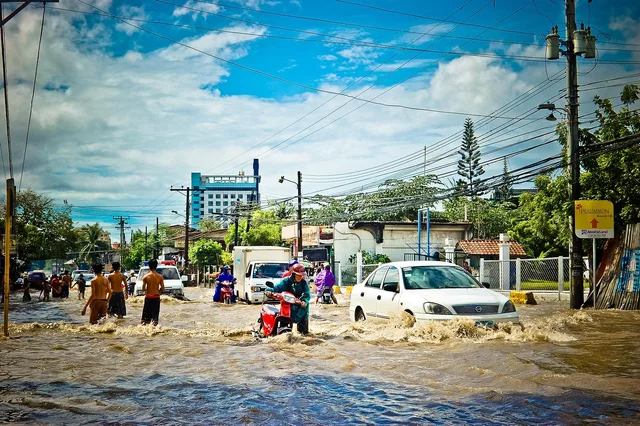
That difference shows up on the second day of a drying job. An eleven hour extraction and setup day bills differently in Vancouver than in Seattle before any wage rate is applied. Storm work adds its own pressure, and Vancouver stormwater rules shape how a firm pumps, dries and documents a coastal flood loss.
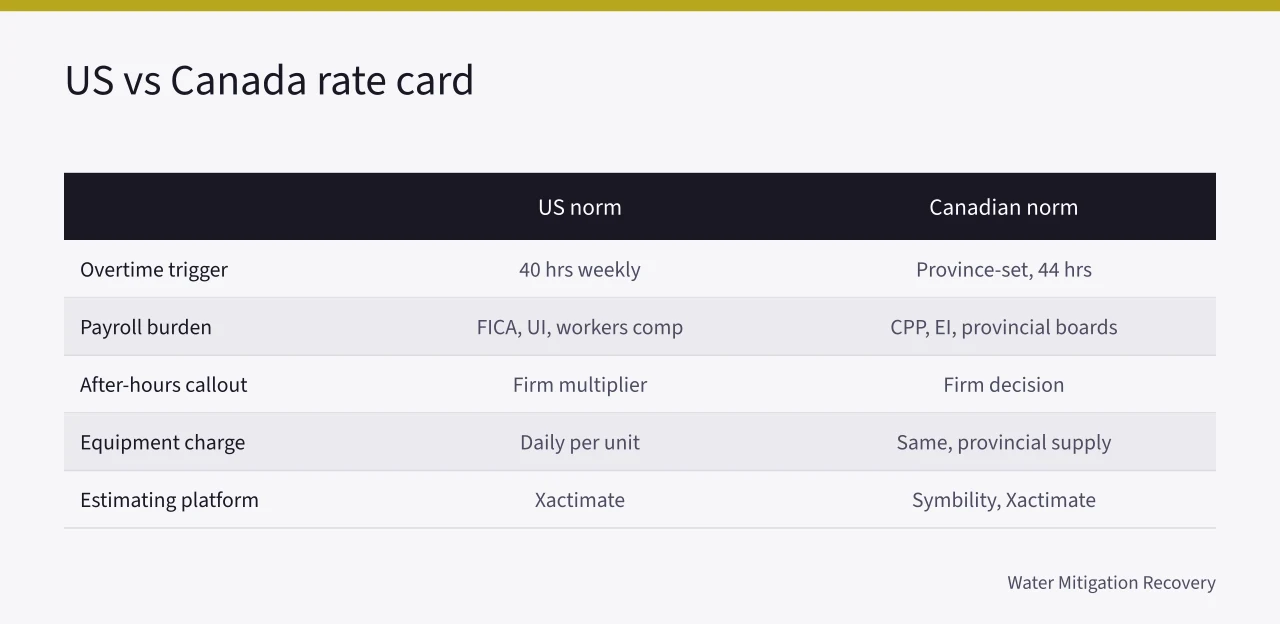
Rate card lines where the two countries diverge
US norm
- Overtime trigger
- 40 hours a week under the FLSA, with stricter daily rules in some states
- Payroll burden
- FICA, federal and state unemployment insurance, workers compensation by class code
- After-hours callout
- A firm multiplier on night and weekend hours
- Equipment charge
- Daily charge per air mover and dehumidifier
- Estimating platform
- Xactimate regional price lists
Canadian norm
- Overtime trigger
- Set by province, for example 44 hours a week in Ontario
- Payroll burden
- CPP and EI employer contributions, provincial workers compensation boards
- After-hours callout
- Also a firm decision, with few provinces regulating the multiplier
- Equipment charge
- Same structure, priced against provincial supply
- Estimating platform
- Symbility by CoreLogic used widely alongside Xactimate
A rate card is a set of rules, not a price list. When the overtime trigger and the equipment day stay visible, the hourly rate can move without the margin moving with it.
Building a crew rate card in five steps
Five steps to a crew rate card
- Pull published wage floor
- Add statutory burden
- Apply overtime rules
- Price equipment day apart
- Make supervision and PPE visible
- Pull the published wage floor. Use BLS OEWS mean hourly wage data for construction and extraction occupations in your state, or the Job Bank wage report for your province and NOC code.
- Add statutory burden. Include FICA and unemployment insurance in the US, CPP and EI in Canada, then workers compensation by class code.
- Apply overtime rules to your real shift pattern instead of assuming a 40 hour week.
- Price the equipment day apart from the labour day so drying hours and crew hours stay visible.
- Make supervision, PPE and documentation visible lines. PPE is a real cost, and OSHA PPE requirements describe what employers must provide at no charge to workers.
Benchmark figures: BLS OEWS May 2023 lists construction laborers (SOC 47-2061) at a mean of USD 24.10 per hour nationally. State means range from about USD 18.00 to USD 38.00.
Job Bank's 2024 report for construction trades helpers and labourers (NOC 75110) gives a national median of CAD 22.00 per hour. Provincial medians run around CAD 24.00 in Alberta, CAD 23.00 in British Columbia, CAD 22.00 in Ontario, CAD 21.00 in Quebec, and CAD 19.00 in Nova Scotia.
Water mitigation technicians typically sit above that floor, at about USD 18.00 to USD 30.00 per hour in the US and CAD 20.00 to CAD 35.00 per hour in Canada before burden.
Example: one class 2 loss, two jurisdictions
Hold the scope still: a class 2 loss, two days, four technicians, twenty air movers and two dehumidifiers. Nothing about the water changes at the border. What changes is the overtime trigger, the employer payroll tax mix and the equipment day rate drawn from the local supply market.
Class and category fix the hours before any rate applies, and the water damage restoration overview explains those categories and drying principles.
Surge and crest work squeezes hours into short windows, which is where overtime rules bite hardest. The comparison of Winnipeg Red River flood risk and Halifax surge shows one market plans around forecast crests while the other plans around tide timing.
Documentation that supports the hours you bill
Drying hours are the largest labour block on most residential jobs, and they are the easiest to argue about. Moisture mapping, daily readings and photographs are the evidence. ASTM's moisture meter guidance covers how measurement in buildings is treated.
Commercial work raises the stakes because the same crew day carries more equipment and more oversight. Commercial jobs add after-hours labour and larger drying equipment, and the commercial water damage pricing page sets out those differences for owners weighing a bid.
Documentation is also becoming part of the product sold. Water restoration trends such as leak detection devices, program dependence and labour scarcity change how many billable hours a job can carry.