Guides
Water restoration license requirements: what to ask
Water restoration license requirements by state: the six questions to put to an agency, who to ask first, and how to log each answer with its date.
Water restoration license requirements are set at the state, county and city level, and they differ from one place to the next. The way to pin down the ones that apply to you is to put specific questions to the issuing body and keep every answer in writing.
What to take away
- Research the requirement yourself, from the issuing body, in writing. A supplier, a franchise recruiter and a competitor all have reasons to tell you it is simpler than it is.
- Ask the question in terms of the work, not the job title. Boards answer "may I remove wet drywall for pay" more usefully than "do I need a license".
- Renewal, continuing education and bonding are separate obligations from the initial grant, and each one can lapse independently.
- Reciprocity between states is usually narrower than the word suggests. Check the specific pair, not the general policy.
- Keep the written answer. A screenshot of the page and the date you read it is worth having when a rule changes.
Requirements vary by state, county and city and they change. This covers the questions to ask, not the rules where you are, so confirm everything with the issuing body.
A few examples show how far apart the answers land. Texas licenses mold remediation contractors through the Texas Department of Licensing and Regulation.
Florida licenses mold assessors and mold remediators through its Department of Business and Professional Regulation. California contractors come under the Contractors State License Board. Whether your own work falls inside one of those regimes turns on the activity, which is why the questions are phrased as activities rather than job titles.
Six questions to put to the agency
Boards and agencies classify activities, while owners ask about occupations. That mismatch is why the same question gets three different answers. Write each question as a specific activity and put it to the agency in that form.
Questions to put to the agency
- May we extract water and place drying equipment?
- May we remove wet drywall, flooring, cabinetry?
- When does work require a contractor credential?
- Is microbial remediation separately regulated?
- Must assessment and remediation be separate companies?
- How do we transport and dispose of waste?
- May we extract water and place drying equipment for compensation in this state?
- May we remove wet drywall, flooring or cabinetry as part of that work, and does the amount matter?
- At what point does the work become construction or repair requiring a contractor credential?
- Is remediation of microbial growth separately regulated, and is there a size threshold?
- Are assessment and remediation required to be performed by different companies?
- What do we need to transport and dispose of contaminated material and demolition waste?
Each of those has a yes or no answer from a named body, which is exactly what you want in a file. A reply that dodges the activity has not answered the question, so put it again in plainer terms.
Who to ask, and in what order
Start with the state contractor licensing board and the state environmental or health agency, then the city or county business licensing office, then the state labor department for employment obligations. Keep a page for each with the contact, the answer you were given, the date, and any reference number.
Who to ask, in order
- State contractor licensing board
- State environmental or health agency
- City or county business licensing office
- State labor department for employment
Before you phone, describe the work accurately. The U.S. Environmental Protection Agency: Mold Cleanup guidance describes what remediation involves and where professional experience is expected, which helps you describe the work correctly when you ask.
Hazards deserve the same care. The U.S. Environmental Protection Agency: Flood Cleanup to Protect Indoor Air and Your Health guidance describes electrical, chemical and biological risks in flood work and the point at which qualified help is needed. No license makes an untrained crew competent for that.
What a complete answer contains
Texas shows what a complete answer contains. The credential is the Mold Remediation Company License issued by the Texas Department of Licensing and Regulation. The company must designate at least one licensed mold remediation contractor as its responsible person.
Its renewal application, form MLD-LIC-014, makes the applicant certify compliance with the Mold Assessors and Remediators Act in Texas Occupations Code Chapter 1958 and Chapter 51. It also certifies compliance with the mold rules at 16 Texas Administrative Code Chapter 78 and the department's universal rules in Chapter 60.
That is the shape to look for in any state: a named credential, the statute and rule chapters behind it, the form, and the individual the company has to name. A reply missing any of the four is a reason to ask again.
Tennessee shows the other common pattern. The Board for Licensing Contractors requires a contractor's license before you bid or negotiate a price once a project's total cost reaches the state's threshold. The trigger is the size of the job rather than the trade.
Log the four obligations separately
A license is not one event. Treat each of these four obligations as a separate item with its own date. Record the issuing body's answer for each in the same log, so a lapse in one stays visible while the others are current.
Four obligations behind a credential
- Initial grantapplication, experience, insurance, bond
- Maintenancerenewal, continuing education, insurance in force
- Scopewhat the credential actually permits
- Notificationownership, address, insurance, qualifying individual
- The initial grantapplication, proof of experience or examination, insurance evidence, and often a bond.
- Maintenancerenewal on a cycle, continuing education where required, and keeping the underlying insurance in force.
- Scopewhat the credential actually permits, which is often narrower than the name implies.
- Notificationtelling the issuing body about changes to ownership, address, insurance or qualifying individual.
Item four is the one that catches growing companies. A change of address or a new qualifying employee can require a filing nobody thought about. Ask the board what it wants to hear about, and by when, then put that date in the log beside the renewal.
Reciprocity: ask about the pair
Reciprocity is narrower than the word suggests. Louisiana shows how it works: present law lets its State Licensing Board for Contractors waive the trade portion of the examination if an applicant holds a license in good standing, or a comparable classification, in another state.
That is a waiver of one exam section, not automatic recognition. The board sits within the office of the governor, and the waiver is the part to confirm with it in writing before you plan to work across a state line.
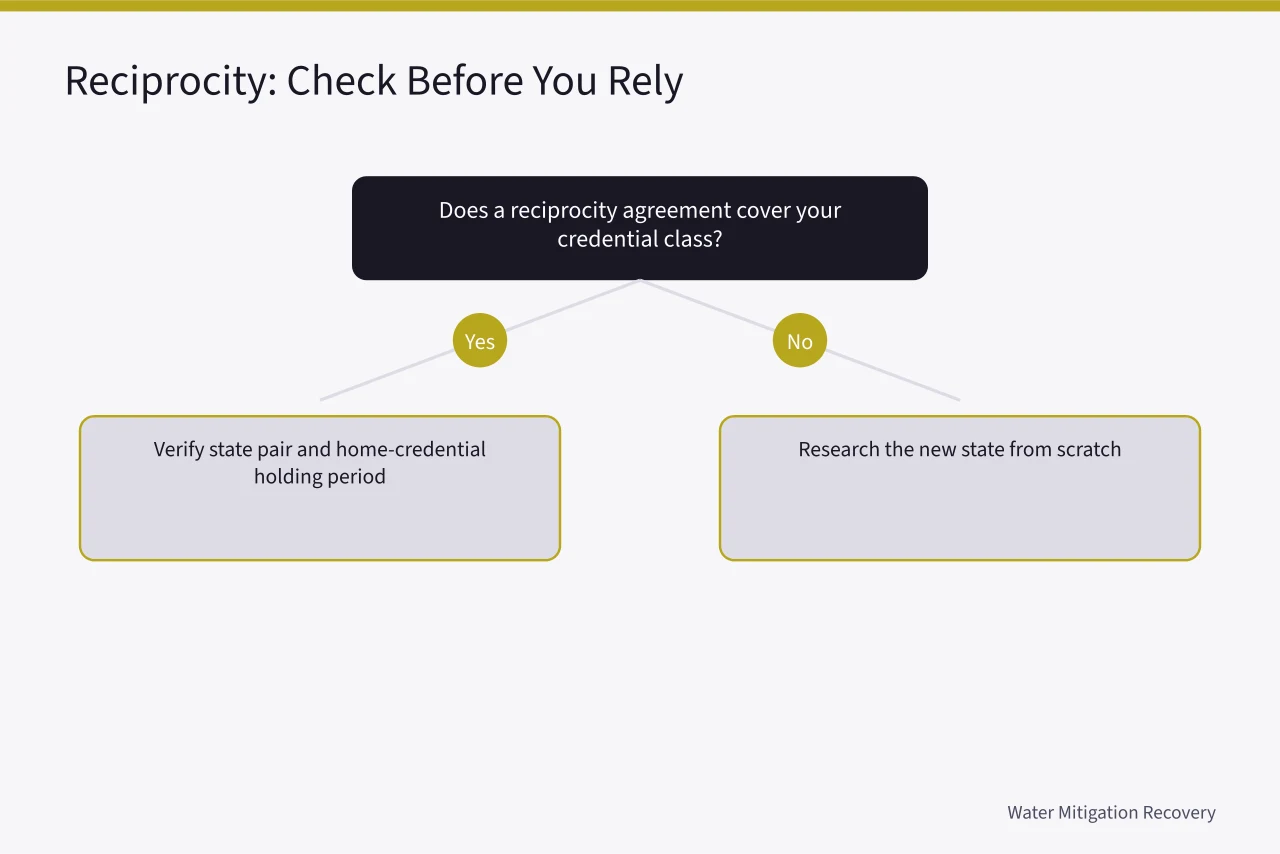
Reciprocity agreements are usually specific pairs of states, often limited to particular credential classes, and frequently require the applicant to have held the home credential for a period. Assume you need to research the new state from scratch, and be pleased if reciprocity shortens it.
The wider stack of registrations, waste rules and employment obligations behind the credential is set out in the guide to licensing and compliance. Each layer has to be checked separately for the new jurisdiction, with the same written-answer discipline as the license itself.
Turning the answers into an operating file
Convert the written answers into three things: a credentials list with renewal dates and an owner, a written scope statement saying what the company may and may not accept, and a trigger list that reopens the research when something changes.
Trigger the review when you add a service, a county, a vehicle class or a hire, and when equipment purchases enable work you could not do before. The full sequence for a new operation sits in the restoration startup guide.
Equipment follows the same rule. Owning air filtration and containment lets you do contaminated work safely; it does not make that work lawful where a credential is required. Recheck the scope whenever the list of owned equipment grows.
Common questions
How long does it take to get set up in a new state?
Longer than the credential itself, because the credential usually waits on insurance, a bond and sometimes an examination date. Work backwards from the first job you intend to take and start the process well before it.
Can we take a job while an application is pending?
Ask the issuing body and get the answer in writing. The general answer is no, and the exceptions where they exist are narrow and specific.
Does a franchise handle licensing for us?
A franchise system may guide the process and it does not hold your permissions. The credential is granted to your company and lapses in your company's name.
What if the agency gives us an unclear answer?
Put the question in writing, describe the activity in detail, and keep the reply. An ambiguous verbal answer is worth nothing later, and agencies are generally willing to confirm in writing when asked plainly.