Guides
Water Mitigation Vancouver: Flood Risks and Crew Planning
Water mitigation Vancouver crews plan for coastal flooding, atmospheric-river losses, stormwater discharge, spills and worker-safety duties on restoration jobs.
What to take away
- Water mitigation Vancouver crews should identify the receiving system and check local requirements before pumping floodwater.
- Coastal surge floods a building from below, through outfalls and foundations, so the water arrives carrying salt and fine sediment rather than rain.
- An atmospheric river drops a season of rain in days and sends dozens of losses to every firm in the region at once.
- The Water Sustainability Act and B.C.'s dike and dam programs matter when work touches a watercourse, ditch or dike crest.
- WorkSafeBC's Occupational Health and Safety Regulation applies from the first hour, and contaminated water is the hazard that drives the paperwork.
- A discharge record, a drying log and a hazard assessment are the three documents an adjuster or a municipality will ask for after the storm.
Stormwater discharge planning for restoration work
Stormwater rules in this region start at the municipal level. Each member municipality writes its own bylaw, and those bylaws set how much stormwater a property may release, how much must be held on site, and what treatment is expected before discharge.
Compliant stormwater discharge steps
- Identify the receiving system before pumping
- Check if water is classified contaminated
- Obtain discharge permit or settling tank
- Document what, where, and authority
- Clean and verify on-site detention system
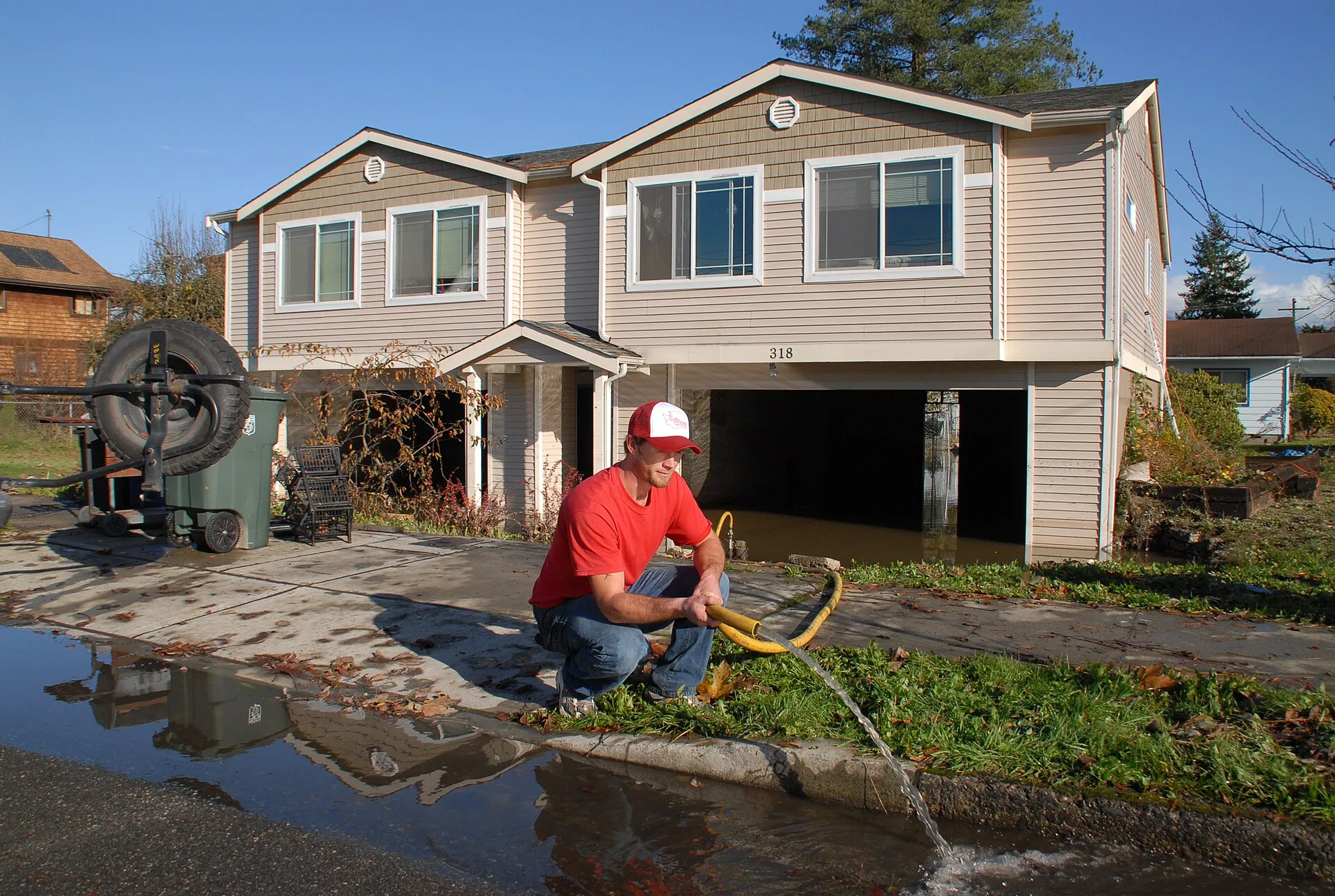
That lands on you at the point of extraction. Pumping a flooded basement into the sanitary sewer is a discharge, and the bylaw may classify that water as contaminated. Many municipalities require a discharge permit, a settling tank, or both. In Vancouver, check the City of Vancouver Sewer and Watercourse By-law No. 8093 and ask the City whether a Waste Discharge Permit applies; nearby municipalities have separate requirements.
Newer developments hold water back with detention tanks, rain gardens, permeable paving and roof storage. After a flood those features are full of silt and they clog, which creates a second job on the same address: cleaning and verifying an on-site detention system.
For a firm considering whether to add this work to its service mix, the expansion and market guide offers a separate business-planning angle.
Stormwater utility fees are charged on impervious area, so a large paved site pays more and the owner has a financial reason to fix drainage instead of repeating the loss.
Document what you discharge, where, and under what authority. Municipalities ask for those records after a storm event, and the firm that cannot produce them carries the risk.
What a compliant discharge looks like
- Identify the receiving system before you pumpsanitary sewer, storm sewer or ditch.
- Check the applicable municipal bylaw—for Vancouver, the Sewer and Watercourse By-law No. 8093—and confirm whether a discharge permit is required.
- Confirm the receiving municipality's written treatment and discharge criteria, including any turbidity or sediment limits; pre-treat with filtration or settling where required.
- Record volume, turbidity, time and discharge point on the job file.
- File the record with the drying log so the file stands on its own.
| Water type | Typical discharge route | Common requirement |
|---|---|---|
| Clean rainwater, no sewage contact | Storm sewer or surface | Often allowed with sediment control |
| Silt-laden floodwater | Storm sewer | Settling or filtration first |
| Sewage-contaminated water | Sanitary sewer | Permit and pre-treatment |
| Water with fuel or chemicals | No sewer discharge | Contain and report |
Coastal flood risk and how it changes mitigation planning in Vancouver
Coastal flood risk here is high tide, storm surge, wind and heavy rain arriving together. It reaches False Creek, the Fraser delta and low-lying parts of Richmond and Delta.
When the sea pushes back up the outfalls, stormwater has nowhere to go. Basements flood from below rather than through a window, and the water carries salt and fine sediment.
Salt changes the drying plan. It leaves residue on framing, electrical components and metal fasteners, and it keeps surfaces conductive after the visible water is gone. Sediment settles into wall cavities and floor assemblies, so cleaning runs longer than a clean-water loss of the same size.
Access is the other variable. During a surge, some routes flood and municipal pumping stations come under strain, so crews with a staging area outside the floodplain move first. Choose high ground with reliable access and clear equipment space, and keep fuel away from drains.
Adjusters in this market now ask for evidence that the drying plan considered the water source. A file that treats a tidal intrusion as a burst pipe will not survive review, which is one reason a quality assurance checklist belongs on every coastal job.
Atmospheric river events and what they do to Lower Mainland properties
Atmospheric rivers are narrow bands of concentrated moisture that stall over the coast and release large volumes of rain in a short period. In British Columbia they arrive mainly between October and March and they hit the Coast Mountains first.
Atmospheric river event response timeline
- October to Marchatmospheric rivers arrive
- Event daysdozens of claims cluster
- During eventequipment and labour scarce
- After rainsaturated ground pushes water in
- Days latersecondary losses appear, schedule return visits
What reaches a building is rarely one thing. Hillside runoff, overwhelmed culverts, backed-up municipal mains and river overflow can all touch the same structure, so the water category can change from room to room.
Losses cluster. One event generates dozens of claims in a few days, and every firm in the region competes for the same dryers, generators and labour. Pre-arranged equipment agreements and a written triage rule decide who you can actually help. A workable rule is to prioritize life safety, active water entry, contamination and safe access; log deferred jobs and the trigger for reassessment.
The provincial response runs on its own timeline, and the public safety and emergency services structure tells a firm when to expect access, fuel and road closures to be managed rather than open. The Ministry of Emergency Management and Climate Readiness coordinates provincial emergency management; local governments and the Ministry of Transportation and Infrastructure manage closures within their jurisdictions. Follow official alerts before dispatching.
The work outlasts the rain. Saturated ground keeps pushing water into foundations for days, and secondary losses show up in buildings that read dry at the first inspection. Schedule return visits instead of closing the file.
B.C. water laws, dikes and dams rules a restoration firm should know
B.C. water laws and rules cover water use, works in and around water, and flood regulation. The Water Sustainability Act is B.C.'s principal water-management statute, and authorization may apply to changes in and about a stream. These laws reach past utilities and farms to anyone who touches a stream, ditch, foreshore or structure that controls water.
Working in or near water
Does the work touch a stream, ditch, foreshore or dike?
confirm authorizing authority first
standard flood work proceeds
A crew clearing a blocked watercourse, setting a pump intake in a ditch, or working near a dike needs to know who authorizes that work. Unauthorized works in and around water create liability that outlasts the drying job.
The provincial drought, flooding, dikes and dams programs set the framework for flood protection infrastructure. The Ministry of Water, Land and Resource Stewardship administers the provincial Dike Safety Program and Dam Safety Program, while local diking authorities maintain local dikes. Firms working near dikes should know which authority maintains them locally, because access and load restrictions apply on and beside dike crests.
Dams add a second layer. Downstream properties can flood from controlled releases rather than rainfall, and the water may arrive with little warning. If a job sits below a dam, ask about release schedules before you commit equipment.
Drought matters to coastal crews in a way that surprises them. Dry ground sheds rain faster, so a heavy fall storm on baked summer soil produces more surface runoff and more basement flooding than the same rain in spring.
Spills and environmental emergencies crews may meet on a flood site
Floodwater mixes with whatever it crosses. On an industrial or commercial site in the Lower Mainland that can include fuel, solvents, agricultural runoff and sewage. B.C. spills and environmental emergencies procedures set out reporting expectations, and a restoration crew is often the first party to notice a release. The Environmental Management Act and Spill Reporting Regulation are the provincial statute and regulation to check for spill-reporting duties. For reporting, contact the provincial Environmental Emergencies line; RAPP (Report All Poachers and Polluters) is another provincial reporting channel.
Spill response on a flood site
- Stop work in the affected area
- Report through the proper channel
- Never pump to a storm drain
- Contain with booms, absorbents and berms
- Photograph everything before moving it
- Ask for the site emergency plan at the door
Know the trigger for calling. Sheen on water, a fuel smell, a damaged tank or a ruptured drum all mean stop work in that area and report through the proper channel. Do not pump it to a storm drain to clear the floor.
Contain first. Booms, absorbents and berms cost little next to a contaminated outfall. Photograph everything before you move it, because the record usually decides who pays.
Some sites carry their own emergency plans. Ask for them at the door on commercial and industrial losses, and follow the site plan where it is stricter than yours. Before accepting spill-adjacent work, verify the applicable licensing and environmental duties; the water restoration license requirements are part of that due diligence.
WorkSafeBC duties on stormwater and contaminated-water jobs
WorkSafeBC OHS rules apply to restoration work the same way they apply to construction. The Occupational Health and Safety Regulation covers hazard assessment, PPE, exposure control, confined spaces and lone work, and a flood site triggers most of them.
WorkSafeBC hazards on flood jobs
- Site hazard assessment signed before work
- Exposure control plan for contaminated water
- Confined space plan, monitor and attendant
- Lock out, test and document electrical risk
- Plan fatigue rotations before the storm
Contaminated water is the central hazard. Treat every flood loss as sewage and chemical exposure until sampling says otherwise, and write an exposure control plan that names the tasks, the controls and the health monitoring that follows. For anything touching a worker's health, follow the regulation and the physician or public health authority, not a crew lead's judgement.
Confined spaces appear quickly. Crawl spaces, sumps, vaults and some mechanical rooms qualify, and entering one without a plan, a monitor and an attendant is a violation rather than a shortcut.
Electrical risk is the quiet one. Water and energised equipment do not mix, and saltwater losses keep surfaces conductive after the visible water is gone. Lock out, test and document.
Fatigue is a genuine hazard during atmospheric river events. Long shifts across multiple sites erode judgement, and the hours and rest provisions exist for that reason. Plan rotations before the storm, not during it.
- Site hazard assessment completed and signed before work starts
- Exposure control plan names contaminated water tasks
- Confined space entry permit and gas monitor on site
- Electrical isolation confirmed and recorded
- PPE matched to the water category, not the room
- Lone work check-in schedule set for after-hours calls
- Incident and near-miss reporting route understood by all crew
Safety records carry commercial weight too. Firms that document method, safety and outcomes hold adjuster and property manager relationships longer, which is why the operators who last treat service standards as a written asset rather than a habit.
This market's storm and safety exposure also belongs in an assessment of the best places to run a restoration business.
Common questions
Does a Vancouver restoration firm need a permit to pump floodwater into the sewer?
Often yes. Municipalities regulate discharge to sanitary and storm systems, and sewage-contaminated or silt-laden water usually needs pre-treatment, a permit, or both. In Vancouver, check the City of Vancouver Sewer and Watercourse By-law No. 8093 and ask the City whether a Waste Discharge Permit applies; other municipalities have their own requirements. Keep any permit on the job file.
How is coastal flood damage different from a burst pipe loss?
The water carries salt and sediment, arrives from below through outfalls and foundations, and keeps surfaces conductive after they look dry. Drying plans, cleaning methods and equipment selection all have to reflect that difference.
What should a crew do if it finds a fuel spill on a flood site?
Stop work in the affected area, contain what you can, and report through the provincial Environmental Emergencies line or RAPP (Report All Poachers and Polluters). Check the Environmental Management Act and Spill Reporting Regulation for applicable reporting duties. Do not discharge it to a storm drain, and photograph the scene before anything is moved.
Who sets worker safety rules on a flood restoration site in B.C.?
WorkSafeBC enforces the Occupational Health and Safety Regulation, which covers hazard assessment, exposure control for contaminated water, confined space entry and limits on excessive hours during storm response. Check the current regulation text and any site-specific plan.