Guides
How to think about water restoration service quality
Water restoration service quality has one hard test: materials reached a documented dry standard and you can prove it. The measures and the reinspection habit.
What to take away
- Quality in this trade has one hard definitionthe affected materials reached a documented dry standard, and you can prove it a year later.
- Everything else customers judge you on is behaviorarriving when you said, explaining what you found, and leaving the house liveable each night.
- Measure callbacks and reinspections. They are the only quality metric that cannot be talked around.
- A daily reading log with no adjustments is not evidence of quality. It is evidence that nobody looked.
- Reviews and referrals follow from the visit, not from a request. Fix the visit first.
Technical standards for a specific building are set by the conditions in it. This page is about running a quality system, not about how to treat a particular loss.
The definition worth using
Ask five owners what quality means and you will get five adjectives. Use a definition instead, with three parts.
Three-part quality definition
- Technicaldry standard from unaffected material
- Readings show the standard was reached
- Evidentialinspection, moisture map, daily readings
- Equipment placement, adjustments, photographs, completion record
- Humancustomer knew what, when, why
The technical part: every affected material reached a dry standard taken from unaffected material of the same type in the same building, and the readings show it.
The evidential part: the file contains the initial inspection, the moisture map, the daily readings at marked points, the equipment placement and adjustments, photographs, and a completion record. Someone who was never there can follow it.
The human part: the customer knew what was happening, when, and why, at every stage, and nothing on the invoice was a surprise.
A job can fail any of the three independently. Companies usually fail the second and blame the first.
What actually goes wrong
Five failures account for most of it, and none of them is a lack of effort.
Five common failures
- 1Drying finished on schedule, not reading
- 2Readings taken at different points daily
- 3Cavity or subfloor never checked
- 4Equipment unchanged while readings flatlined
- Drying declared finished on a schedule rather than on a reading, because the equipment was needed elsewhere.
- Readings taken at different points each day, so the trend means nothing.
- A cavity or a subfloor never checked, which surfaces as an odor or growth weeks later.
- Equipment left in place unchanged for days while readings flatlined.
- The customer told nothing between the first visit and the invoice.
Notice how many are documentation failures wearing a technical costume. The reading points are the clearest case: unmarked points produce a log that cannot show progress even when the building is drying perfectly.
The measures that mean something
- Callback ratejobs that required a return for a drying-related reason. The single most honest quality number in the business.
- Reinspection findingswhat a second pair of eyes finds on a sample of completed jobs.
- Days to dry against the plan, by job type.
- Percentage of jobs with a complete daily reading log at every marked point.
- Percentage of jobs with pre-existing condition photographs taken before work began.
- Scope reduction at review, which usually measures documentation rather than pricing.
- Customer contactwhether anyone spoke to the customer on each day equipment was in the building.
Track these monthly. Compare each to your own last quarter rather than to an industry figure, since no published average knows your job mix.
Measures to track monthly
- Callback rate for drying-related returns
- Reinspection findings on completed jobs
- Days to dry against plan by job type
- Complete daily reading log at marked points
- Pre-existing condition photographs before work
- Scope reduction at review
- Customer contact each day equipment is present
Reinspection, and why it has to be somebody else
Pick a sample of completed jobs each month and have someone other than the crew that ran them read the file and, where possible, visit. Look for the reading points, the adjustments, the photographs, and whether the completion record matches the inspection.
Monthly reinspection routine
- Pick a sample of completed jobs
- Someone other than the crew reads the file
- Visit the property where possible
- Check reading points, adjustments, photographs
- Confirm completion record matches inspection
- Ask if work should have been referred out
This is uncomfortable the first three times and then becomes the most useful hour of the month. It finds the habits nobody would report: a technician who skips the crawlspace, a crew that never photographs before moving furniture, a monitoring visit logged from the truck.
The principle is the same one that governs safety work: a system that only learns from complaints learns slowly and expensively. Look for the problem before a customer finds it.
Hold the technical boundary at the same time. The U.S. Environmental Protection Agency: Flood Cleanup to Protect Indoor Air and Your Health guidance describes conditions under which a job needs qualified help. A reinspection is a good moment to ask whether a crew took work it should have referred out.
Reviews, honestly
Good work produces reviews when you ask for them plainly and make it easy. What it does not permit is gating, incentives that buy a rating, or writing a review on a customer's behalf.
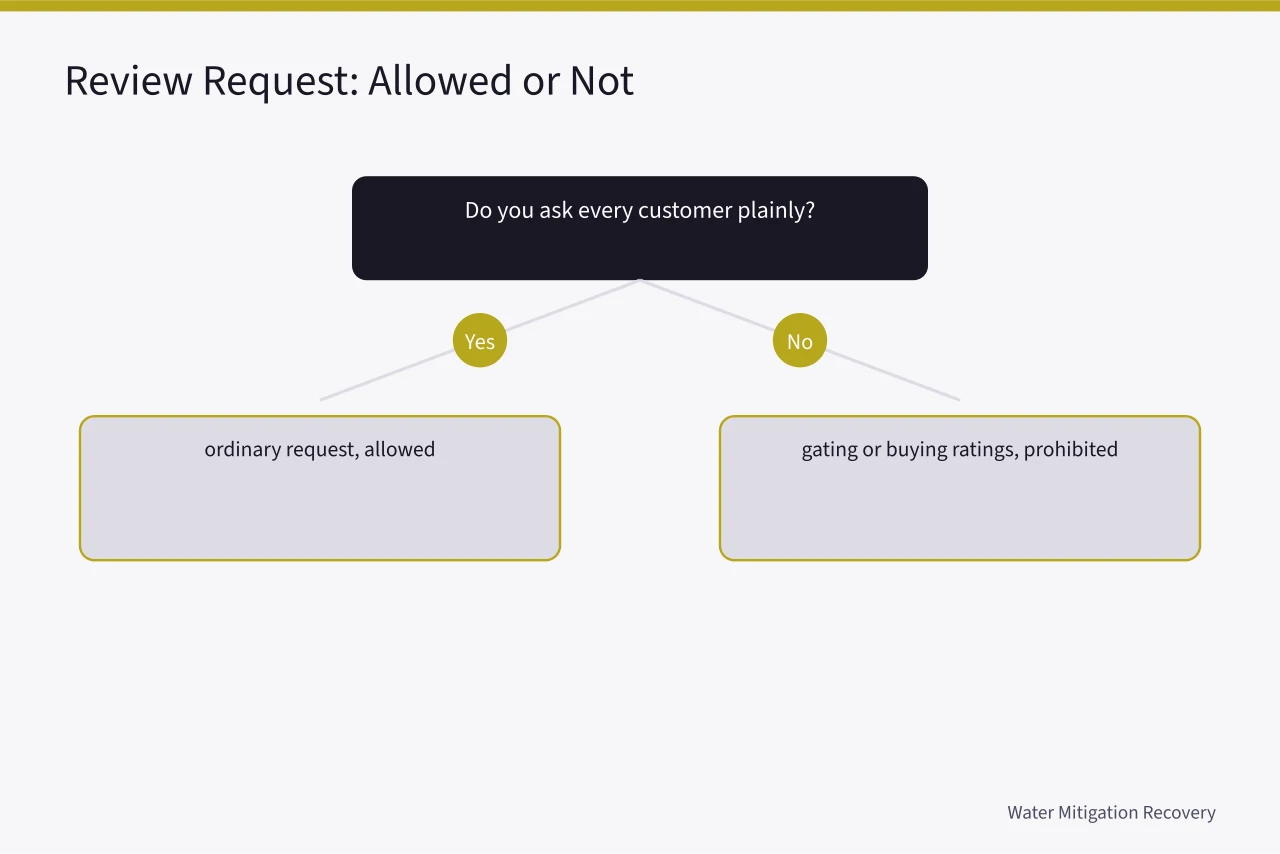
Read the U.S. Federal Trade Commission: Soliciting and Paying for Online Reviews: A Guide for Marketers guidance once if you handle customer follow-up. The line between an ordinary request and a prohibited practice is narrower than most small companies assume.
Ask everyone, not just happy customers. Respond to what comes back without revealing anything private about the property or claim.
Where quality meets everything else
Quality is not a separate department in a small company. It is a consequence of four other decisions.
The service lines you agreed to sell decide whether the crew works within its competence. The fleet you own and how you size it decides whether a drying plan can run at all.
The pricing and profit model decides whether the job has room for a proper monitoring visit. The licensing stack and training position decide what you may accept, and a quality problem is usually one of those four showing up late.
Job records hold the whole system together. The expectation behind them is set out in the Internal Revenue Service: What kind of records should I keep? guidance. Staffing quality has a cost, and checking your pay assumptions against the [U.S.
Bureau of Labor Statistics: Occupational Employment and Wage Statistics Tables](https://www.bls.gov/oes/tables.htm) is a reasonable way to find out whether you are trying to buy careful work at careless rates. Whether the market you chose rewards that standard is a separate question, and in most places it does, slowly, through referral.
The four conversations that prevent most complaints
Quality failures that reach a customer are usually communication failures wearing technical clothes. Four short conversations, at fixed points, prevent most of them.
On arrival, before touching anything. Walk the property together, photograph the pre-existing condition and say why. Explain what you have found in plain words, without dramatizing it and without criticizing whoever worked on the building before. Say what you will do today.
Before work begins. Explain the emergency visit, the drying period, and that the length depends on findings nobody has yet. Say who is responsible for the deductible. Get the authorization signed. This conversation takes five minutes and removes the two commonest sources of anger at invoicing.
Every monitoring visit. One sentence about where the job stands. A customer living with equipment noise for a week and hearing nothing assumes the worst, and that assumption becomes the review.
At completion. Walk the property again, show the final readings, hand over the completion record and say plainly what was done and what was referred out. Then ask for a review in the same words you use with everyone.
None of these requires a script, a system or a budget. What they require is that they happen on every job rather than on the jobs where somebody remembered. Put them in the written standard and check for them at reinspection, because a crew that skips the arrival conversation is the crew whose file is thin later.
Common questions
How do we know a building is dry?
By comparing the affected material against a dry standard measured from the same material, unaffected, in the same building, at the start. Not by how it feels, and not by the fifth day arriving.
What is an acceptable callback rate?
Lower than last quarter. A published benchmark cannot know your job mix, and the useful comparison is your own trend with the causes written next to each event.
Should crews be paid on speed?
Be careful. Paying on jobs closed rewards declaring dry early, which is the exact failure mode you most want to avoid. If you incentivize anything, incentivize complete documentation and a clean reinspection.
The customer is satisfied but the file is thin. Is that a quality problem?
Yes, and it is the most common one. A satisfied customer today does not help you when a claim, a sale of the house, or a growth complaint arrives eighteen months from now with nothing in the file.